Recovery Skills Training
One hour a week with your therapist.
This is for the other 167.
Finally, a program that teaches you how to actually do eating disorder recovery.

Self-paced. Built by a licensed therapist who's been through it, too.
$497, or 4 payments of $147 · Lifetime access.
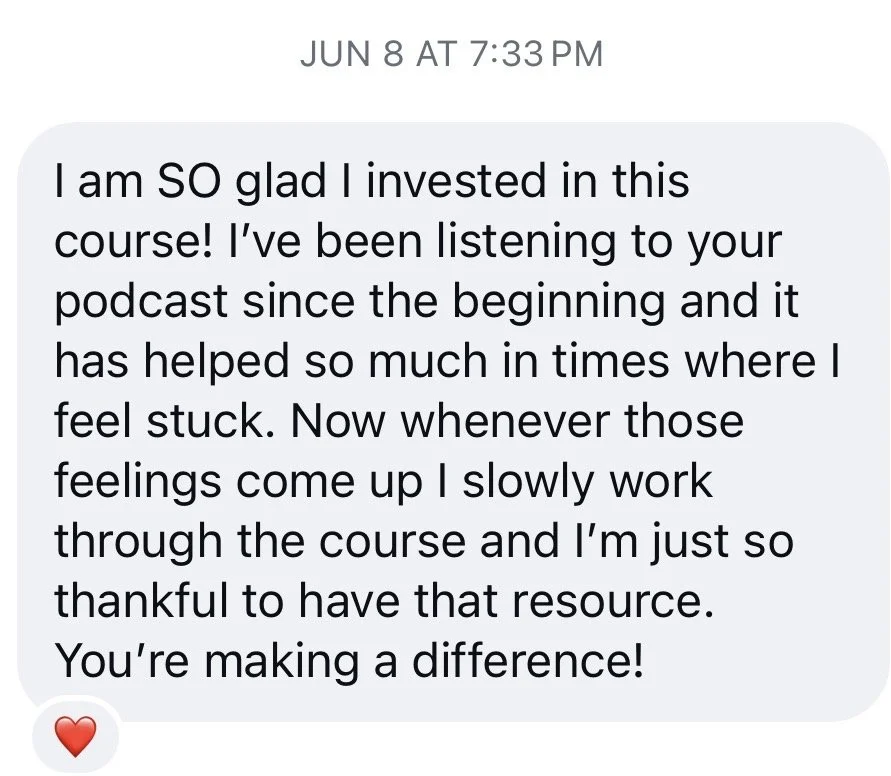
Real results from real students:
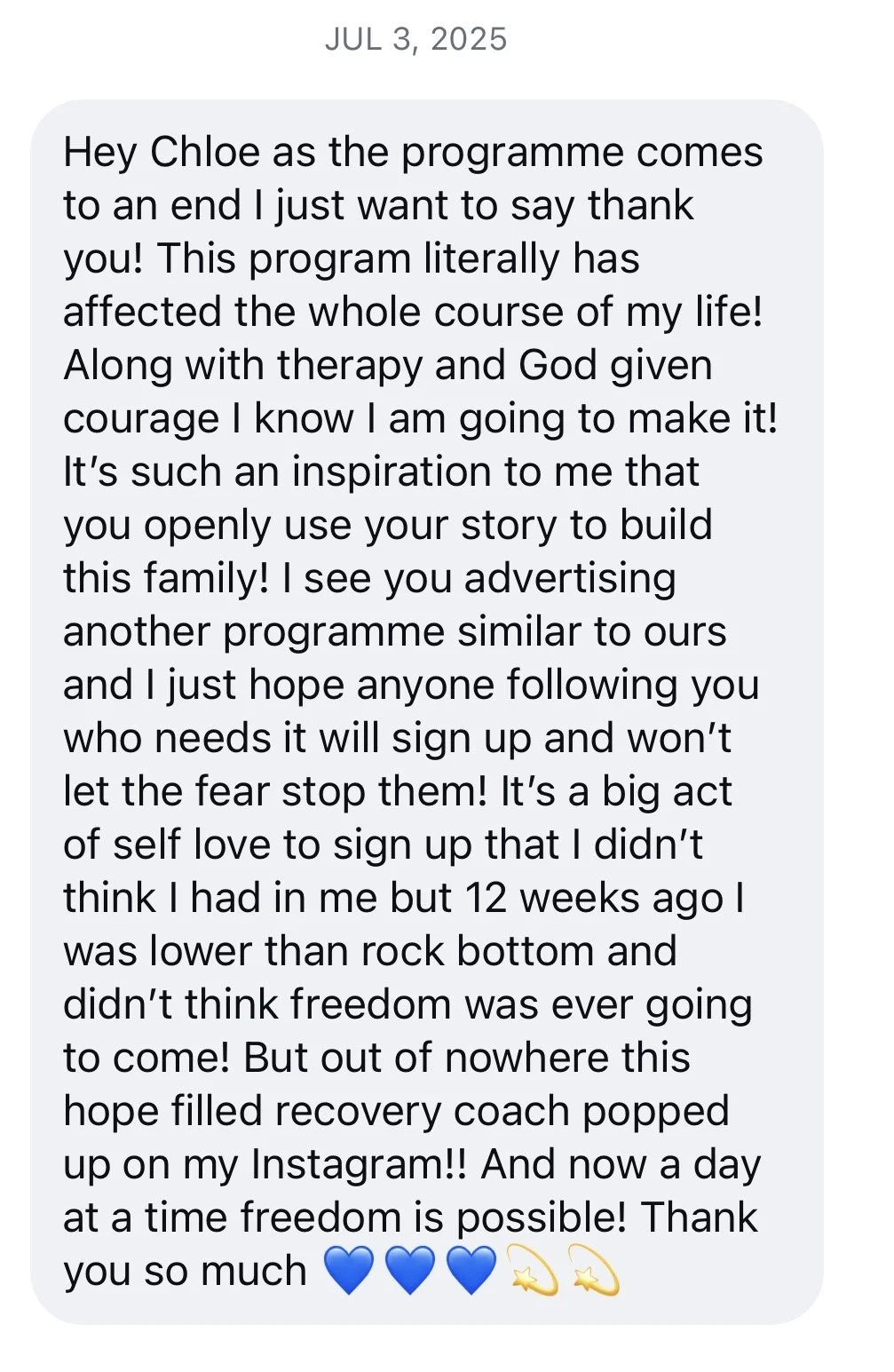
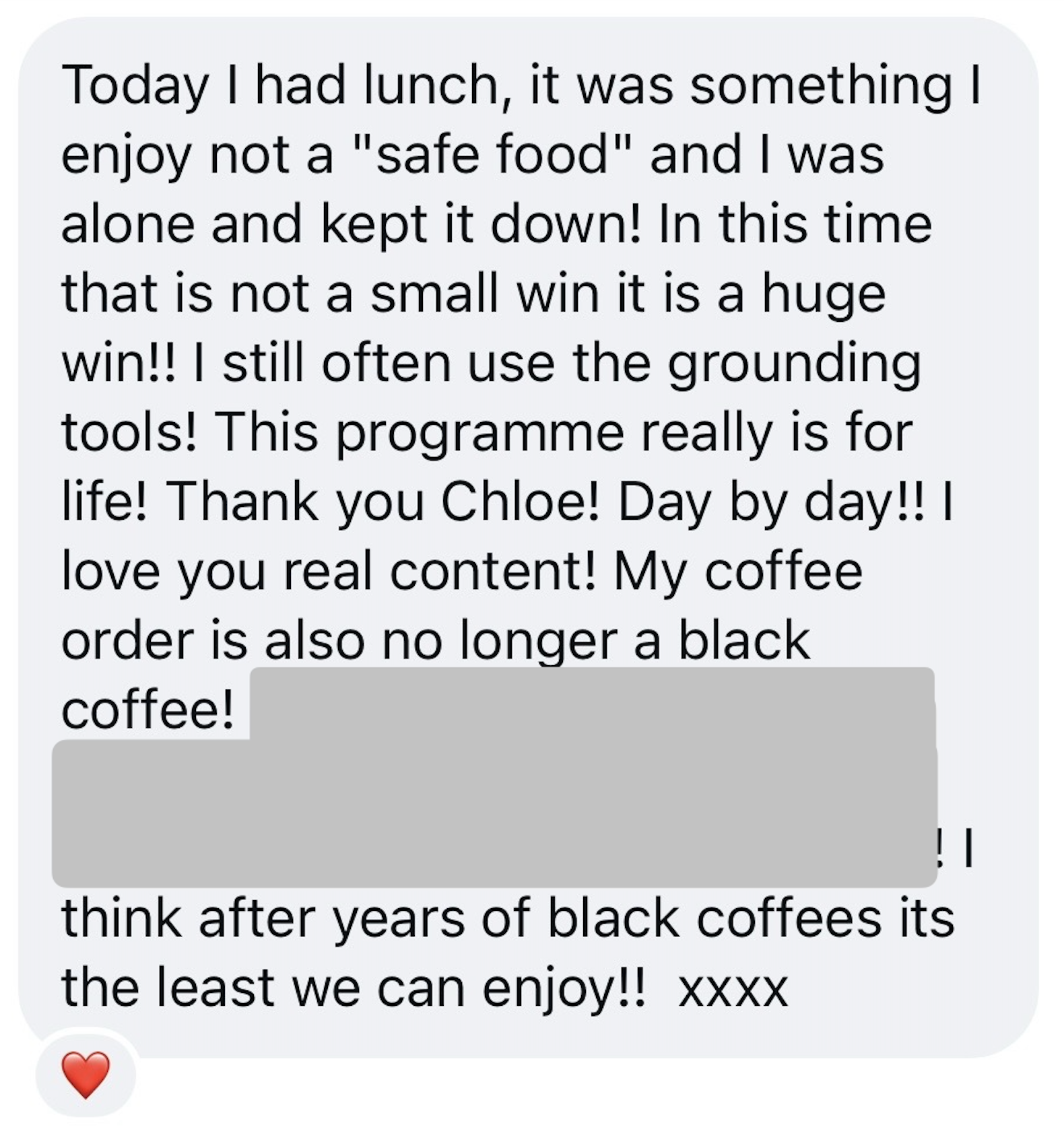
The hard part was never understanding it.
Recovery asks you to eat when everything in you says don't.
To make decisions about food all day, every day, whether or not you have the capacity that day. To do the thing differently — and then sit in whatever floods in afterwards. And then get up tomorrow and do it again.
Doing things differently while your nervous system is telling you, loudly and convincingly, to STOP is usually when we start to breakdown. It’s just not sustainable.
I’ll say it plainly: some days it is genuinely easier to stay with the behaviors than to work towards recovery. When you’re overwhelmed, not amount of “motivation” stops a fight/flight response.
The eating disorder is right there, and it works quickly. Of course, it’s going to be hard to resist.
We mistake this as a willpower problem. It’s not.
It's a skills problem.
One hour a week isn't enough.
Not when your ED is 24/7.

If you have a therapist, that hour is probably the most useful of your week. I know mine was!
But there are 168 hours in a week, and recovery happens in the other 167.
At the table. In the fifteen minutes after a meal. On the drive home from brunch. At 4pm on a Tuesday when you’re freaking out after afternoon snack.
That's where the eating disorder actually operates, and it's the part you're mostly left to work out alone.
Recovery Skills Training is built for those hours. Not as a replacement for therapy — as the mechanism that makes therapy functional between sessions.
What you'll have at the end:
By week twelve you'll have a complete toolbox — and you'll know which tool is for which moment.
How to get through an urge without white-knuckling it or waiting it out alone.
How to tolerate what comes up afterwards, which is usually the harder part.
How to change a behavior and actually stick to it, including on the days you don't want to.
How to analyze your own patterns — what the real roadblocks are, and what to do about them instead.
How to stand up to the eating disorder when it's being persuasive.
How to hold onto recovery in the real world, with the family dinners and the comments and the fitting rooms in it.
A sense of who you are that the eating disorder isn't controlling.

Insight alone didn't heal me either.
When I was deep in my eating disorder, I knew what I was doing was harming me. But I couldn't stop.
I understood a great deal about it. I could have explained it to you. What I didn't have was anything to do with what I understood — and no way of getting through the hours between the understanding and the next meal.
I’d leave therapy with clarity and motivation…but when the next meal arrived, all of that disappeared.
What changed was learning the specific, practicable skills: navigating urges, tolerating distress, nourishing myself, retraining a nervous system that had learned all the wrong things, and slowly becoming someone whose life wasn't organized around food rules.
The key was insight + action. Both at once.
That's what I've spent my career teaching — as a licensed therapist, international recovery coach, and as someone who's done it herself.
Every week works three layers at once.
Most of what's available works one of them well and leaves the other two alone.
That's why it takes you a long way and then stops.
Your eating disorder isn't a bad habit — it's a part of you doing a job it took on for a reason. You'll meet the rule-keeper, the exercise enforcer, the body-image protector. You'll find out what each is afraid of. And then you'll give it a different job. Parts that get fought come back. Parts that get reassigned don't.
The ED Part:
You can know your worth has nothing to do with your body and still feel your chest go tight when you look in the mirror. That’s because you’re activating a totally different system, and it doesn't respond to being “told things.”
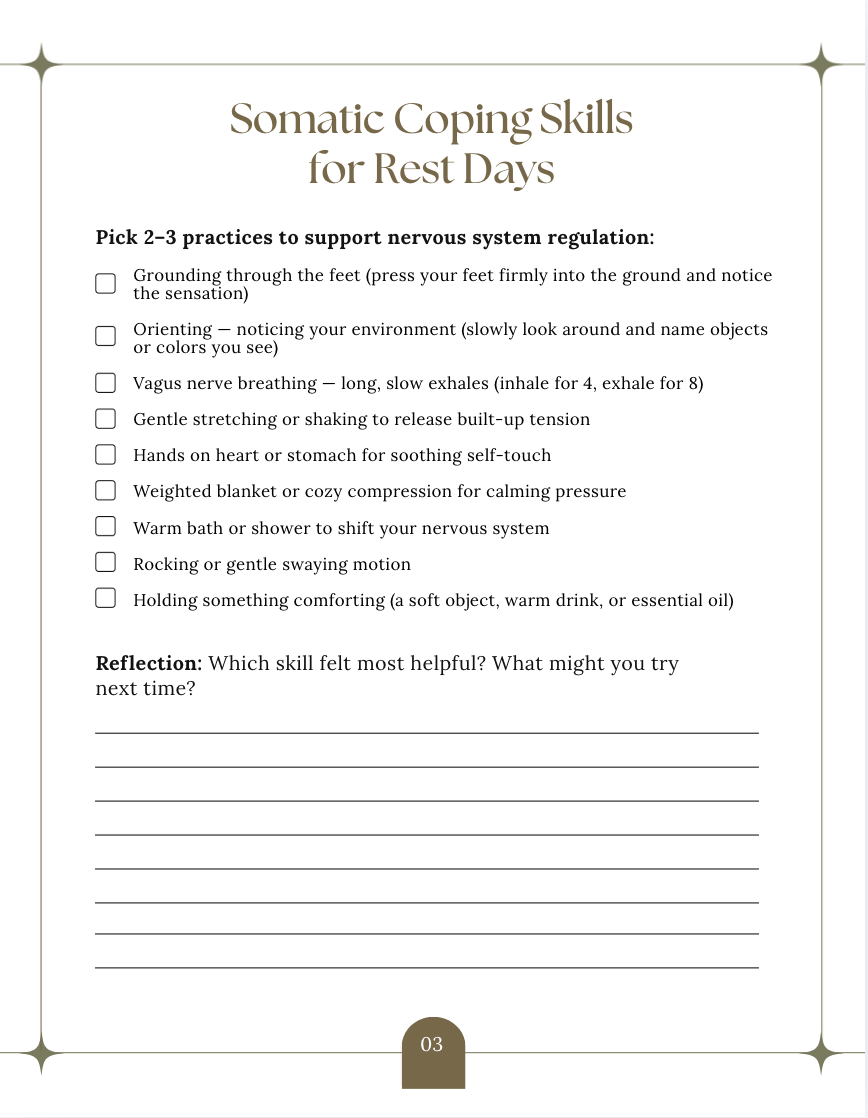
The body doesn’t respond to logic, so we work it directly: interoception, grounding, pendulation, regulation you can reach at a dinner table rather than only on a cushion.
The Body:
Then it gets concrete. Urge surfing. Delay protocols. Behavior chain analysis, so you can see exactly where the chain could have broken. If/then plans written in advance, for the moments when you won't be in any state to invent one.
The Behavior:
This is the system and the structure that locks in sustainable recovery.



The Twelve Weeks:
| 01 · Understanding Disordered Eating & Reclaiming Your Why | You know exactly where you are and what you're doing this for |
| 02 · Nourishment, Not Rules | Food rules you'd stopped noticing become visible — and optional |
| 03 · Disrupting Eating Disorder Behaviours | You have something to do in the moment, not just afterwards |
| 04 · Body Image and Worth | A bad body image day stops costing you the whole day |
| 05 · Healing Your Relationship with Movement | Rest without negotiating for it |
| 06 · Reclaiming Food Freedom Through Internal Leadership | Decisions made from your own judgement instead of from fear |
| 07 · Embodied Boundaries & Reclaiming Safety | You can say no without three days of guilt afterwards |
| 08 · Identity Expansion & Reclaiming Joy | You remember who you were before this organised everything |
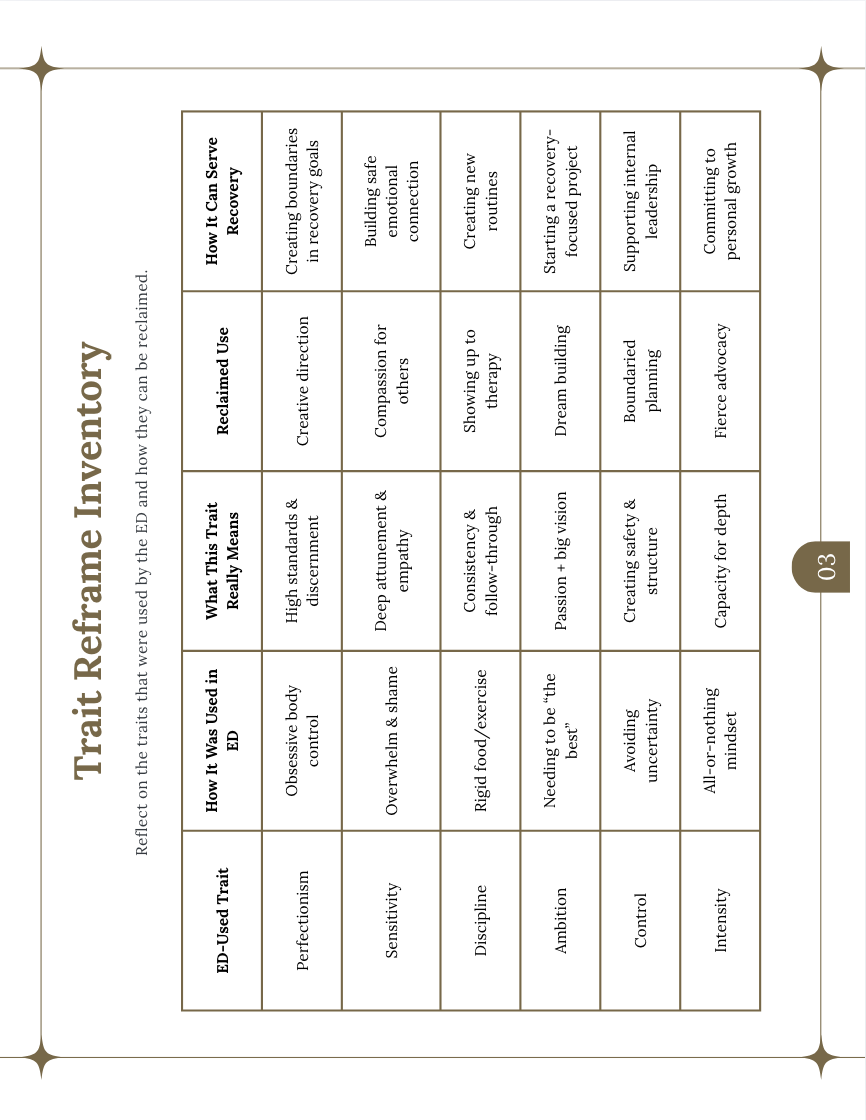
| 09 · Reclaiming Your Strengths | The traits it hijacked come back working for you |
| 10 · Recovery in the Real World | Holidays, travel, comments, fitting rooms — planned for in advance |
| 11 · Relapse Resilience & Recovery Maintenance | You come back faster, and it costs you less each time |
| 12 · Defining Recovery on Your Terms | Your definition, written down and specific |
What's included:
Twelve weeks of video teaching, with me — 30 to 60 minutes per module.
The 166-page Recovery Skills Workbook. This is where the method actually happens.
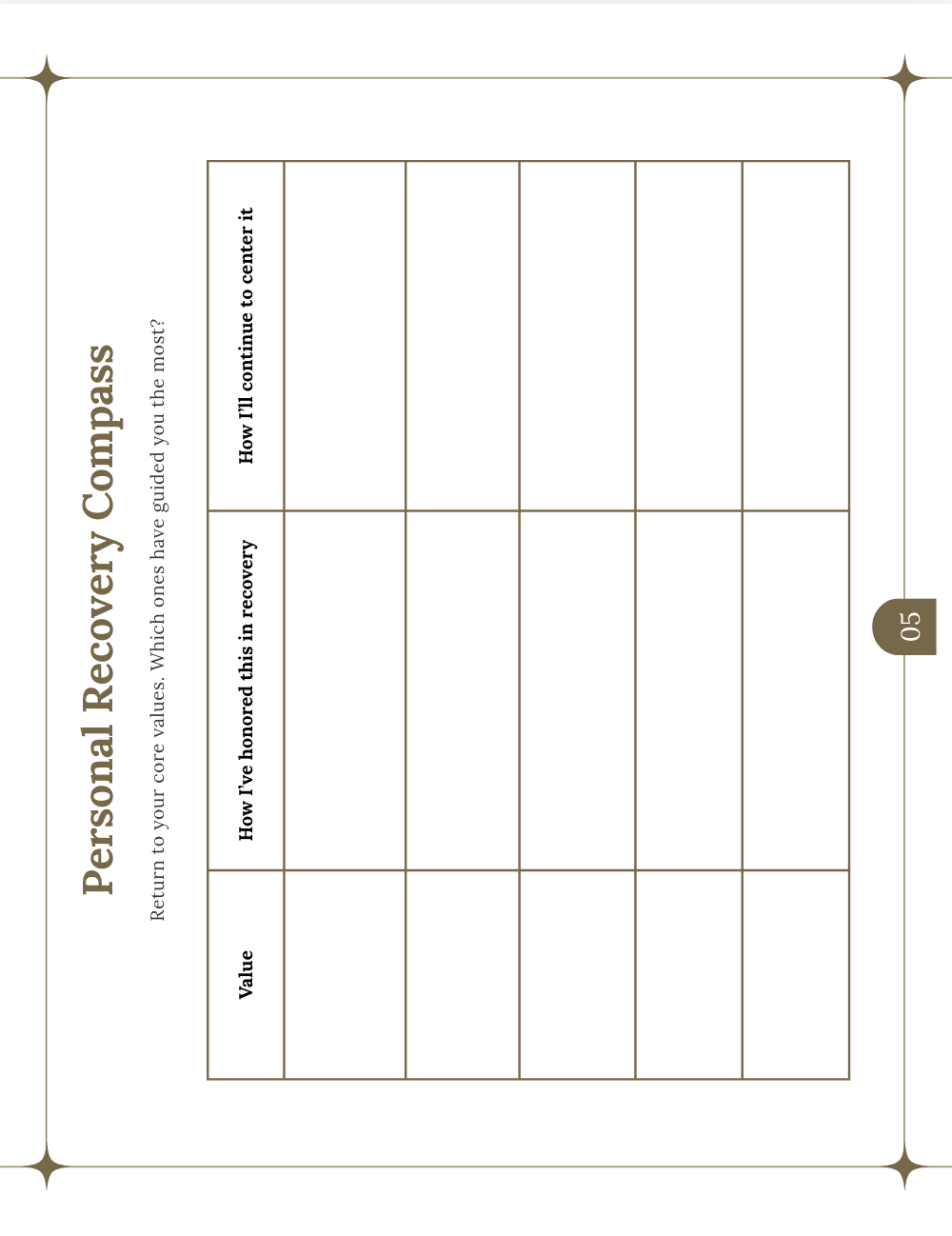
Trigger awareness logs. Urge tracking sheets with intensity ratings. Full behaviour chain analyses. Structured parts dialogues, nine questions deep. Week-long somatic check-in grids. If/then relapse plans. Word-for-word scripts for diet talk and body comments. A support map.
The guided somatic library — meditations, visualisations and body scans, recorded and ready.
Resource sheets and coping toolkits throughout.
Your Recovery Menu and Emergency Recovery Plan, built in weeks 10 and 11.
Lifetime access, including every future update.
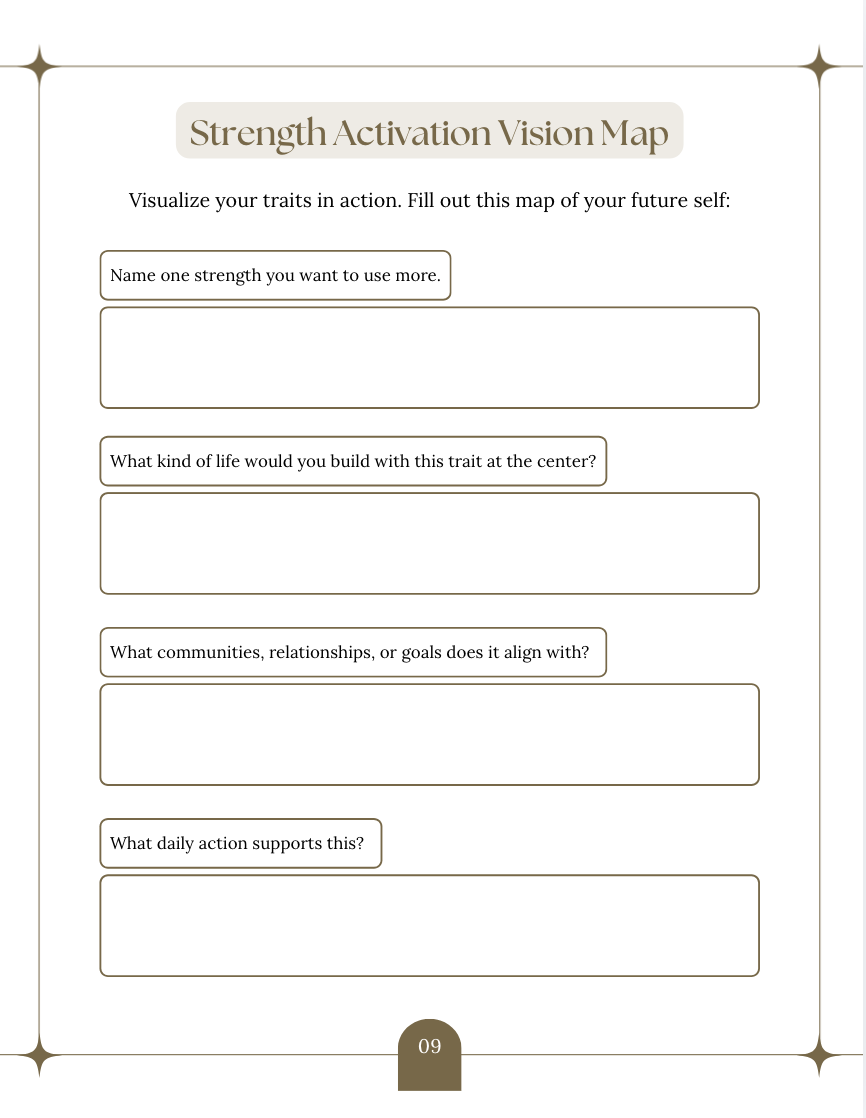
Imagine having me in your back pocket:
Who this is for, and who it isn't

This is probably right for you if:
You know roughly what recovery asks of you and the doing of it is what's hard.
You want structure — something to work through weekly rather than more scattered advice.
You have a therapist and one hour a week isn't covering it.
You don't have a therapist and need somewhere to start.
You're a therapist or dietitian who wants a structured skills resource to work alongside your clients.
You want to work at your own pace, privately, from anywhere.
This is probably NOT right for you if:
You're medically unstable, or your treatment team has told you that you need a higher level of care. A course cannot do that job, and I'd rather say so now than take your money.
You're hoping this will help you control your eating more precisely. It will do the opposite, on purpose.
You want someone to look at your specific situation and tell you what to do. That's coaching or therapy, not a self-paced course — and I offer both.
What this is, precisely:
Recovery Skills Training is education and skills training. It is not psychotherapy, it is not treatment, and it is not a substitute for either — which is also why it's available to you wherever you live.
If you're working with a therapist or dietitian, this is built to sit alongside them. Bring the workbook to your sessions, and take the work deeper there.
Recovery Skills Training
$497 — one payment
or 4 × $147 — payment plan
Twelve weeks. Yours for life.
Roughly the cost of two therapy sessions, for the other 167 hours in the trenches.

Questions?
-
That's the most common thing people say to me before they buy, and it's a fair thing to be wary about. The honest answer: most of what's available gives you understanding, and understanding is where nearly everyone already is. What's usually missing is what to actually do in the 167 hours you're not in a session — how to get through an urge, how to tolerate what comes afterwards, how to keep going on the day it'd be easier not to. That's what this is built for.
-
Both, deliberately. You'll do substantial reflective work — parts dialogues, narrative work, values clarification, somatic practice — all of it drawn from evidence-based approaches and taught as skills you practice rather than treatment you receive.
And every piece is paired with something to do, because insight alone doesn't heal. If you're expecting a list of tips, this isn't that. If you're expecting pure reflection with nothing to do at the end, it isn't that either.
-
Not a substitute for therapy, and yes, a great companion for outpatient treatment. It was built precisely because a couple hours of support each week isn't enough. Most people here have a therapist, a dietitian, or both. Bring the workbook to your sessions if it's useful.
If you’re in residential, PHP, or IOP I’d recommend prioritizing recommendations from your team before purchasing this course.
-
No. Week one starts by working out where you are, and everything builds from there. Nothing assumes you've done therapy or treatment.
-
Also no — and it's the more common worry. The early weeks aren't an introduction to eating disorders, they're the foundations the later work sits on.
Most people who've been at this a long time find the missing piece somewhere in weeks two to four — not because it's new information, but because it's the first time it's been put in an order and paired with something to do.
-
Nearly everyone who buys this thinks one or the other. If food takes up more of your head than you want it to, that's the only entry requirement.
-
No. No calorie counting, no weighing, no measurements, no meal plans. The tracking that exists is about urges, triggers and body signals — never food or bodies.
-
Then stop. Everything's unlocked and permanent, so you can leave week four for three months and come back. Weeks 1, 3 and 11 are the ones to start with if you're in a rough patch.
And if you're in crisis, please get a treatment team — email me and I'll help you find one.
-
Fair question. And I’m able to provide a good amount of free content!
The power of the course is the structure, direction, breadth of resources, and high level specificity that I can’t breakdown in a podcast series or Instagram post. The course is the sequence, the workbook, and not having to figure out what comes next to push your recovery forward.
-
About an hour. A 30–60 minute video and 20–30 minutes in the workbook. The workbook is where the change happens, so if you're going to skimp on one, skimp on the video.
The actual material is less time consuming than the daily implementation you’ll be guided to work on.
-
No. Fully self-paced, no group — deliberately. Nobody sees you, nobody's waiting on you, and nothing depends on you being free on a particular evening.
This provides both privacy and flexibility as you learn.
Give me twelve weeks.
Recovery is requires more than motivation. It takes tools, insight, and practice.
Because the eating disorder doesn’t quit after you leave therapy. It's there in the fifteen minutes after a meal. It's the drive home. It's Tuesday at 4pm when nobody's watching and the easier thing is right there.
Nobody hands you the skills for that.
Twelve weeks, about an hour a week, and at the end you'll have a full toolbox and know which tool is for which moment.
I can't promise you where your recovery goes — nobody honest can. I can tell you that you won't be doing those 167 hours empty-handed.
$497, or 4 × $147 · Lifetime access